Jaws and teeth
They have 30 teeth with canines up to 7 cm long. Bite force reaches up to 500 kg.
King in myths
and nature
Where does the word 'tiger' come from?
The word tiger comes from the Greek tigris, with roots in the Iranian tigri (arrow) or Old Persian tigra (pointed). This symbolism of speed and sharpness accompanies the tiger across cultures.
In Asia, it is revered as a messenger of the gods who protects forests. In Chinese culture, the pattern of stripes on a tiger's forehead resembles the character for the word 'king'. While Western cultures once portrayed it as a dangerous beast, today it is a symbol of elegance and nobility.
The tiger is the largest land predator after the polar bear and brown bear.
A tiger's roar can be heard up to 3 km away.
The exceptionally white coloring of a tiger is not albinism but rare leucism (only in the Bengal tiger).
The word tiger comes from the Greek tigris, with roots in the Iranian tigri (arrow) or Old Persian tigra (pointed). This symbolism of speed and sharpness accompanies the tiger across cultures.
In Asia, it is revered as a messenger of the gods who protects forests. In Chinese culture, the pattern of stripes on a tiger's forehead resembles the character for the word 'king'. While Western cultures once portrayed it as a dangerous beast, today it is a symbol of elegance and nobility.

The tiger is the largest land predator after the polar bear and brown bear.
A tiger's roar can be heard up to 3 km away.
The exceptionally white coloring of a tiger is not albinism but rare leucism (only in the Bengal tiger).
They have 30 teeth with canines up to 7 cm long. Bite force reaches up to 500 kg.

Males weigh 180–250 kg (Amur up to 384 kg!). Females are smaller (100–160 kg).

Tigers are excellent swimmers and can swim up to 8 km. They run at speeds up to 80 km/h and can leap over 10 m.

No two tigers have identical stripes. They have about 100 stripes, and if you shave a tiger, the stripes remain visible on the skin.

Their vision is 6x better than humans. Their sense of smell, on the other hand, is their weakest sense.

They live on average 12–18 years, in zoos around 20 years.
Tigers are solitary animals. Females reach sexual maturity at 3-4 years and males at 4-5 years.
Males and females only meet during mating, which is very loud and intense (up to 50 times a day).
After 103 days, tigresses give birth to 2-4 cubs in caves or thickets. Cubs are born blind and don't leave their mother until age three, when she gives birth to the next litter.
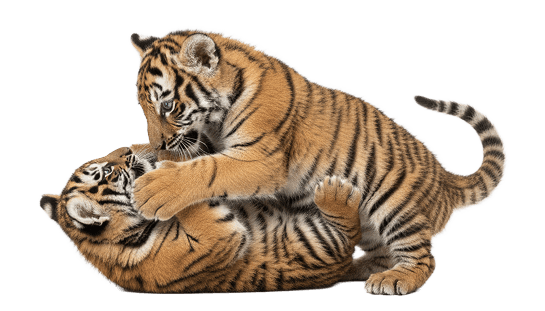
High mortality!
Up to 75% of cubs do not survive to adulthood.
6 to 14 days
after birth, cubs are blind
800 to 1600g
is the birth weight of cubs
2 months
cubs feed exclusively on milk
from 6 months
cubs begin to hunt small birds

They hunt mostly at night. They stalk prey against the wind and attack with a lightning leap from about 20 m away.

Their favorites are wild boar, deer, and buffalo. In the wild, wild boar make up to 50% of their diet. They can devour up to 70 kg of meat at once.

They succeed in roughly 2 out of 10 attempts. However, in a single feeding they can consume up to 40 kg of meat. They consume around 50 large prey animals per year.









Today, 3x more tigers live in captivity than in the wild. Let's change that together.